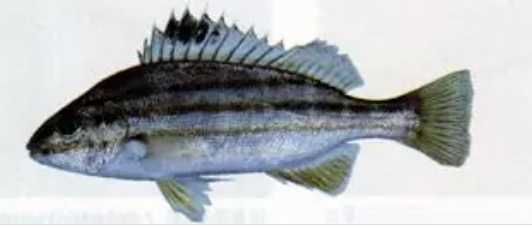
Growing up to 35 centimeters in length, the four-banded terapon features a slightly concave forehead, large reflective eyes, and a small, protractile mouth equipped with fine teeth, ideal for feeding on small invertebrates and fish. Its dorsal fin is divided into two sections: a spiny anterior part with 12–13 sharp spines for defense and a soft-rayed posterior part for agile movement. The caudal fin is deeply forked, enhancing its speed and maneuverability in open waters. Juveniles often exhibit brighter bands and a slimmer profile, which remain prominent throughout adulthood, aiding in camouflage among seagrass beds and coral reefs.
Inhabiting shallow coastal areas, lagoons, and the brackish waters of estuaries, Pelates quadrilineatus is highly adaptable to varying salinity levels, often venturing into freshwater rivers during the rainy season. It forms loose schools during the day, foraging for crustaceans, mollusks, and small fish near the substrate, and seeks shelter in submerged structures or vegetation at night. During spawning, adults migrate to nearshore waters, releasing pelagic eggs that drift with currents until hatching. Juveniles rely on mangrove ecosystems for protection, where the dense roots provide both shelter and abundant food sources.
Commercially, the four-banded terapon is valued in artisanal fisheries for its firm, white flesh, commonly caught using gillnets and traps. However, its populations face threats from habitat degradation due to mangrove deforestation, coastal pollution, and overfishing. As a keystone species in estuarine food webs, it plays a vital role in transferring energy between marine and freshwater environments, making its conservation crucial for maintaining ecosystem health. Initiatives such as mangrove restoration, marine protected areas, and sustainable fishing practices are essential to safeguarding this iconic terapon and the biodiverse habitats it depends on. By preserving Pelates quadrilineatus, we protect the intricate balance of tropical coastal ecosystems for future generations.